 Redose
The best peptides for recovery are compounds that target the body's own repair pathways: reducing inflammation, promoting tissue remodeling, and supporting the cellular machinery behind healing. BPC-157, TB-500, and a handful of others have attracted significant research interest, though most evidence comes from animal studies and early human data rather than large clinical trials.
Important: The peptides described here are investigational compounds. None are FDA-approved for therapeutic use in humans. This article summarizes what existing research reports; it is not a treatment recommendation. Always consult a qualified healthcare provider.
Quick-Reference: Top Peptides for Healing
| Peptide | Best For | Typical Form |
|---|---|---|
| BPC-157 | Tendons, ligaments, gut lining | Injectable (subcutaneous/intramuscular), oral capsule |
| TB-500 (Thymosin Beta-4 fragment) | Muscle, connective tissue, angiogenesis | Injectable (subcutaneous) |
| GHK-Cu | Skin repair, collagen synthesis | Topical cream, injectable |
| Thymosin Alpha-1 | Immune modulation during recovery | Injectable (subcutaneous) |
| CJC-1295 / Ipamorelin | Growth-hormone-mediated tissue repair | Injectable (subcutaneous) |
BPC-157: The Most-Studied Recovery Peptide
BPC-157 (Body Protection Compound-157) is a synthetic 15-amino-acid peptide derived from a protein found in human gastric juice. It has generated more recovery-focused research than almost any other peptide in this category.
What the research shows
Animal studies (predominantly in rats) have consistently found that BPC-157 accelerates healing of:
- Tendon and ligament injuries, including Achilles tendon transections
- Muscle tears, where treated animals showed faster fiber regeneration
- Gut lining damage, including healing of NSAID-induced lesions and colitis models
- Bone fractures, with some evidence of improved callus formation
The proposed mechanisms include upregulation of growth-factor signaling (particularly VEGF and EGF pathways), modulation of nitric oxide synthesis, and direct anti-inflammatory activity. Human trials are limited. A small number of case-series reports exist, but no large randomized controlled trials have been published as of early 2026.
Typical protocols reported
Research and clinical-use reports commonly describe subcutaneous injections of 200 to 500 mcg per day, often split into morning and evening doses, for cycles of 4 to 12 weeks. Some users take it orally for gut-specific applications, though bioavailability via that route is debated. If you want to calculate exact volumes from your vial concentration, the free reconstitution calculator at /calculators does the math for you.
TB-500: Broad Connective-Tissue Recovery
TB-500 is a synthetic fragment of Thymosin Beta-4, a naturally occurring 43-amino-acid protein expressed in most tissues of the body. The fragment used in TB-500 is the actin-binding domain (amino acids 17 to 23) believed to be responsible for most of the protein's bioactivity.
What the research shows
Thymosin Beta-4 research spans several decades. Key findings relevant to recovery include:
- Angiogenesis: TB-4 promotes the formation of new blood vessels, which is critical for delivering oxygen and nutrients to injured tissue.
- Cell migration: It facilitates movement of repair cells to wound sites, potentially speeding early-phase healing.
- Muscle and cardiac tissue: Some studies in animal models of heart injury found reduced scar formation and improved function with TB-4 treatment.
- Anti-inflammatory signaling: TB-4 appears to downregulate several inflammatory cytokines.
TB-500 is often stacked with BPC-157 in practice, with the rationale that BPC-157 targets local tissue repair while TB-500 supports systemic and vascular recovery. This combination has not been formally studied; the reasoning is extrapolated from their individual mechanisms.
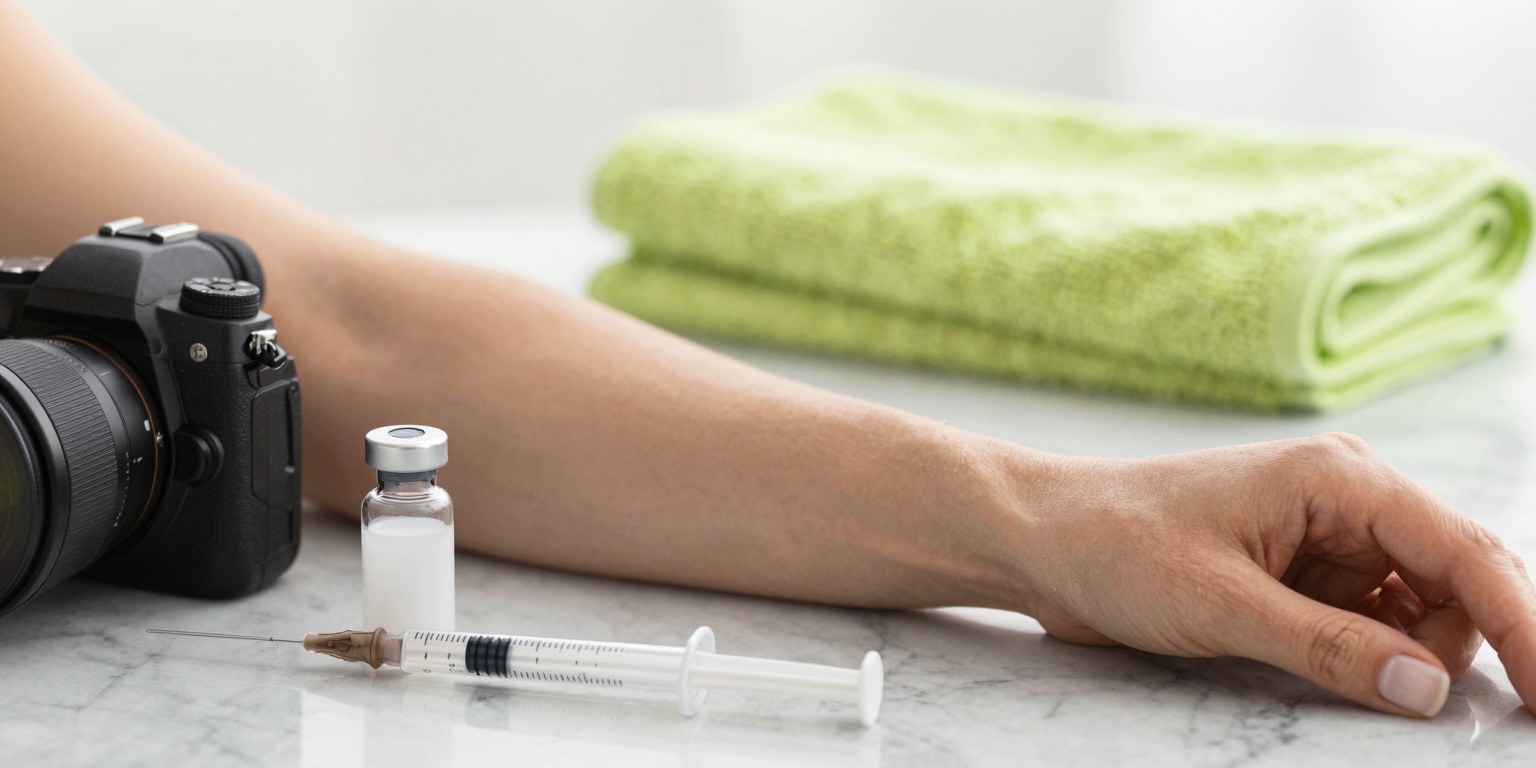 A typical subcutaneous injection setup: a small lyophilized peptide vial, bacteriostatic water for reconstitution, and an insulin syringe.
GHK-Cu: Skin, Collagen, and Wound Healing
GHK-Cu (copper peptide) is a naturally occurring tripeptide (glycine-histidine-lysine) bound to copper. It is present in human plasma and declines with age.
Research (primarily in cell culture and some human wound-healing studies) suggests GHK-Cu:
- Stimulates collagen and elastin synthesis
- Promotes wound contraction and re-epithelialization
- Has antioxidant and anti-inflammatory properties
Unlike BPC-157 and TB-500, GHK-Cu has a broader history of use in cosmetic formulations, and topical applications have some human data behind them. Injectable forms are less studied.
Thymosin Alpha-1: Supporting Immune Function During Recovery
Thymosin Alpha-1 (Tα1) is derived from the thymus and plays a role in T-cell maturation and immune activation. It is the basis for Zadaxin, a drug approved in several countries (though not the U.S.) for hepatitis B and C, and used off-label to support immune function.
In a recovery context, Tα1 is sometimes used to prevent immune suppression during intense training or following surgery or illness. It is distinct from TB-500 (Thymosin Beta-4) despite the similar name.
CJC-1295 and Ipamorelin: Indirect Recovery via Growth Hormone
CJC-1295 (a GHRH analogue) and Ipamorelin (a GHRP) are often combined to stimulate pulsatile release of growth hormone. Their recovery relevance is indirect:
- Growth hormone supports IGF-1 production, which drives tissue repair and protein synthesis
- The combination is studied for lean-body-mass maintenance, sleep quality, and recovery from intense physical stress
- Neither directly repairs tissue; rather, they shift the body toward an anabolic, repair-favorable state
Because they work through the growth-hormone axis, protocols are typically timed around sleep (late evening) to align with the body's natural GH pulse.
How to Use Recovery Peptides Practically
A few practical considerations that apply across this category:
- Storage matters. Lyophilized (freeze-dried) peptides are stable at room temperature for shipping but should be refrigerated after reconstitution. Most lose potency quickly if left at ambient temperature once reconstituted.
- Reconstitution accuracy. Dosing errors are common because most peptides require diluting a lyophilized vial with bacteriostatic water. Even small errors compound across a protocol. Use the free reconstitution and dosage calculator at /calculators to confirm your volumes before you draw.
- Injection-site rotation. Subcutaneous peptide injections should be rotated across sites to prevent lipodystrophy. See how to rotate injection sites for a practical guide.
- Stacking. BPC-157 and TB-500 are among the most common pairings. If you're managing a stack, tracking becomes more complex: which compound, which vial, which dose, which site.
Track Your Recovery Protocol with Redose
If you're running a structured recovery protocol, keeping accurate records matters: both for seeing what's working and for having clear data to share with your doctor. Redose (free on iOS and Android) handles one-tap dose logging, vial inventory with remaining-dose countdowns, injection-site rotation, and protocol scheduling. It's built specifically for peptide protocols, so you're not hacking together a notes app.
Conclusion
The best peptides for recovery (BPC-157, TB-500, GHK-Cu, and others) work through distinct but complementary mechanisms: local tissue repair, angiogenesis, collagen synthesis, and immune modulation. The research base is growing but remains largely preclinical. If you're exploring peptide therapy, pair that curiosity with accurate dosing tools and professional medical guidance.
This article is educational information, not medical advice. Talk to a qualified healthcare provider before starting any protocol.