 Redose
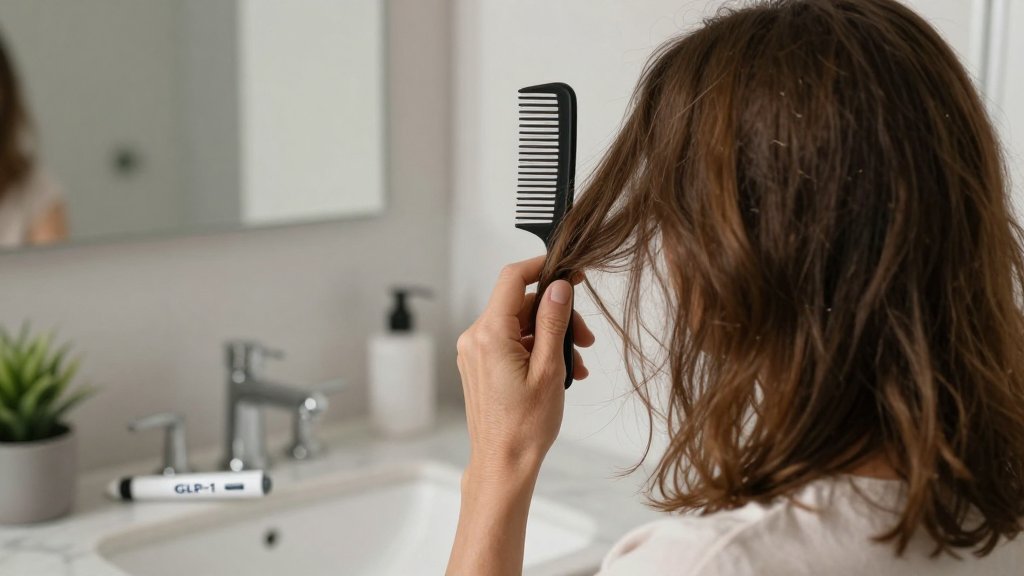
Yes, in a measurable minority of people. The Wegovy prescribing information now lists hair loss among its common adverse reactions, and so does Zepbound's, which answers the old question, can Ozempic cause hair loss, more directly than any forum thread ever did.
So does Ozempic cause hair loss? Ozempic's diabetes trials aren't where the clearest numbers sit. Wegovy is the same molecule, semaglutide, at higher weekly doses for weight management, and both manufacturers write that the shedding in their trials was associated with weight reduction. That phrase matters, and it shapes most of what follows.
What the labels say about GLP-1 hair loss
Here's the raw data from the two current US labels. In Novo Nordisk's pooled weight-management trials, hair loss was reported in 3.3% of people on Wegovy 2.4 mg and 1% on placebo. The newer 7.2 mg dose pushed it to 5.8%. Lilly's label for Zepbound shows 4% to 5% across the 5 mg, 10 mg and 15 mg arms, against 1% on placebo.
| Drug and dose | Hair loss | Placebo |
|---|---|---|
| Wegovy 2.4 mg weekly | 3.3% | 1% |
| Wegovy 7.2 mg weekly | 5.8% | 1% |
| Zepbound 5 mg weekly | 5% | 1% |
| Zepbound 10 mg weekly | 4% | 1% |
| Zepbound 15 mg weekly | 5% | 1% |
Those are small absolute numbers. Put them side by side, though, and the pattern is plain: roughly three to six times the placebo rate, and it grows with the larger Wegovy dose, which also produces more weight loss.
Both labels use nearly identical wording: hair loss adverse reactions were associated with weight reduction. Neither describes a direct effect on the follicle.
Why women report semaglutide hair loss far more often
The sex split is the most striking detail in either document. On Wegovy 7.2 mg, 8.4% of women reported hair loss versus 0.2% of men. On Zepbound, the pooled figure was 7.1% of women and 0.5% of men, compared with 1.3% of women on placebo.
The numbers by sex
- Wegovy 7.2 mg: 8.4% of women, 0.2% of men
- Wegovy 2.4 mg, 7.2 mg trials: 5.4% of women, 0% of men
- Zepbound pooled trials: 7.1% of women, 0.5% of men
- Placebo arms: 1.3% to 2% of women, 0% of men
Why the gap might exist
The labels don't explain it, and we won't pretend to. One plausible reason is reporting: shedding tends to be more visible, and more often noticed, in longer hair. Another is that women were a large share of these trial populations. Either way, if you're a woman on a higher dose, the published risk for you is well above the headline 3% to 5%.
Telogen effluvium and the lag that confuses everyone
Dermatologists usually describe weight-loss shedding as telogen effluvium. Normally about 80% to 90% of your hair is in the growth phase, according to Cleveland Clinic. A physical stress, including fast weight loss, pushes more follicles into the resting phase at once, and they fall out weeks to months later.
The American Academy of Dermatology puts normal shedding at 50 to 100 hairs a day and says most people notice the excess a few months after the triggering event. It also says hair tends to regain its normal fullness within six to nine months. That lag is why many people blame the latest dose increase when the real trigger happened a season earlier.
Normal shedding runs 50 to 100 hairs a day. Telogen effluvium usually shows up a few months after the trigger, not the week it happens.
How the timing lines up with titration
Wegovy trials escalated doses over 16 weeks before reaching 2.4 mg, and Zepbound climbs 2.5 mg at a time every four weeks, as covered in our tirzepatide dosage chart. Weight loss is often fastest during those months. If shedding appears a few months after that, it can overlap with a later dose step that had nothing to do with it.
- Months 1 to 4: dose escalation and often the steepest weight drop
- A few months later: excess shedding may become visible
- Six to nine months after onset: AAD says fullness tends to return
- A dated weight log makes the true trigger much easier to spot

A new BMJ study on Mounjaro and hair loss
In July 2026 The BMJ published a comparison of nearly 40,000 patients with type 2 diabetes, reported by ScienceDaily. People on semaglutide or tirzepatide had a 37% higher risk of alopecia than people on SGLT-2 inhibitors, at 6.91 versus 5.04 cases per 1,000 person-years, and a 68% higher risk than people on DPP-4 inhibitors.
That's relevant to Mounjaro hair loss reports because Mounjaro is tirzepatide at diabetes doses, the same drug as Zepbound. It's an observational study, so it shows association rather than cause. The risk increase was even larger for non-scarring alopecia, the kind that's usually reversible, at 53% and 72% respectively.
What an observational signal can and can't tell you
- It covers real-world diabetes patients, not a trial population
- It compares GLP-1 users to users of two other diabetes drug classes
- It can't separate the drug from the weight loss it produces
- Absolute rates stayed under 7 cases per 1,000 person-years
What tirzepatide hair loss means for staying on treatment
This is the outcome most people actually care about: does shedding end treatment? In the Zepbound trials, no one on tirzepatide stopped because of hair loss, and one placebo patient did. In the Wegovy 7.2 mg program, hair loss led to one permanent discontinuation, one temporary interruption and five dose reductions, against none at 2.4 mg or placebo.
Put differently, among thousands of trial participants, zepbound hair loss cost almost nobody their treatment, and the higher semaglutide dose was the one place it changed dosing at all. Given what each month of these medications costs, that's worth knowing before a bad week in the shower turns into a rushed decision. Any change to your dose is a conversation for your prescriber, not the bathroom mirror.
In the Zepbound trials, zero tirzepatide-treated patients discontinued because of hair loss. One placebo-treated patient did.

Tracking Wegovy hair loss without guessing
Because the trigger and the shedding are months apart, memory is a bad record for sorting out Ozempic and hair loss. A dated log of doses, weight and side effects lets you and your clinician see whether shedding started after a steep drop, a dose change or a stretch of low appetite. Nutrition also comes up in almost every dermatology write-up, with protein, iron and zinc named by Cleveland Clinic, and our piece on protein and muscle on GLP-1s covers intake in more depth.
- Log each dose with the date, amount and injection site
- Record weight weekly at the same time of day
- Note when shedding starts and roughly how heavy it seems
- Write down low-intake days, since appetite drops can be steep
- Bring the log to appointments instead of reconstructing it
Redose is for tracking and record-keeping only; it doesn't diagnose hair loss or suggest treatment. What it does is keep that timeline in one private place, alongside the dose calculators and our overview of long term Ozempic side effects.
Does Ozempic cause hair loss? Answers to common questions
Does semaglutide cause hair loss directly?
The labels don't say so. Both the Wegovy and Zepbound prescribing documents tie the hair loss they recorded to weight reduction, and dermatologists generally describe it as telogen effluvium, which fast weight loss from any cause can trigger.
Is Ozempic hair loss permanent?
Telogen effluvium is usually temporary. The American Academy of Dermatology says hair tends to regain its normal fullness within six to nine months once the trigger has passed. Shedding that doesn't follow that pattern, or comes with patchy bald spots, is worth showing to a dermatologist.
Is tirzepatide hair loss more common than semaglutide?
Not clearly. Zepbound's label shows 4% to 5% versus 1% on placebo, while Wegovy shows 3.3% at 2.4 mg and 5.8% at 7.2 mg. The trials were run separately, with different populations and weight loss, so a head-to-head comparison from these numbers isn't reliable.
When does GLP-1 hair loss usually start?
Dermatology guidance says excess shedding typically appears a few months after the triggering event. For people on a GLP-1, that often means months after the fastest stretch of weight loss rather than right after a new dose.
Track every dose with confidence, and see how your weight, doses and side effects line up over months instead of guessing. Download Redose for exact syringe units from the calculator, gentle reminders, injection site rotation and a complete private log of your protocol. Get the app here: iOS.