 Redose
The best peptides for muscle growth sit at the intersection of sports science and cutting-edge biochemistry. These are compounds that influence growth hormone release, IGF-1 signalling, and tissue repair to help athletes and recreational lifters build and maintain muscle more efficiently. Most are investigational and not approved by the FDA for muscle-building purposes, so the evidence base ranges from robust (for some mechanisms) to early-stage (for clinical outcomes). What follows is an honest breakdown of the peptides people use most often, why they use them, and what the research actually supports.
Quick-Reference Table
| Peptide | Best For | Typical Form |
|---|---|---|
| IGF-1 LR3 | Muscle hypertrophy, satellite cell activation | Sub-Q or IM injection |
| CJC-1295 | Growth hormone pulse amplification | Sub-Q injection |
| Ipamorelin | Clean GH release, minimal side effects | Sub-Q injection |
| BPC-157 | Tendon/muscle repair, injury recovery | Sub-Q or oral (research) |
| TB-500 | Systemic tissue healing, flexibility | Sub-Q or IM injection |
| Hexarelin | Potent GH release, short-term use | Sub-Q injection |
IGF-1 LR3: Directly Targets Muscle Hypertrophy
Insulin-like growth factor 1 Long R3 (IGF-1 LR3) is a modified analogue of naturally occurring IGF-1 with an extended half-life of roughly 20-30 hours compared to the native molecule's minutes. IGF-1 acts downstream of growth hormone to stimulate protein synthesis, promote satellite cell proliferation (the precursor cells to new muscle fibres), and inhibit protein breakdown.
Animal studies and in-vitro research consistently show IGF-1 LR3 producing meaningful hypertrophic effects. Human data is limited and mostly indirect: researchers observe elevated IGF-1 correlating with greater muscle mass in clinical populations, but controlled trials specifically on LR3 supplementation in healthy adults are sparse. Early research suggests it may enhance nutrient partitioning and recovery when resistance training is paired with adequate protein intake.
Typical reported protocol: 20-50 mcg per day, post-workout, for 4-6 week cycles, with extended breaks. Dosing must be precise, as insulin-like compounds carry real hypoglycaemia risk if overdosed. A reconstitution calculator is essential for accurate dilution before every cycle.
CJC-1295: Extending the Growth Hormone Pulse
CJC-1295 is a synthetic analogue of growth hormone-releasing hormone (GHRH). Where natural GHRH produces brief GH pulses, CJC-1295 (particularly the DAC, or Drug Affinity Complex, version) binds to albumin in the bloodstream and extends each GH pulse significantly, sometimes for days with a single injection.
A small number of published human studies, including early Phase I/II trials, confirmed that CJC-1295 with DAC raised mean GH levels and IGF-1 concentrations dose-dependently in healthy adults. More muscle-specific outcomes remain understudied in formal trials, but the mechanistic logic is sound: more GH over time supports greater protein synthesis, fat mobilisation, and connective tissue repair, all of which feed into long-term muscle development.
Typical reported protocol: 1-2 mg per week (DAC version), often combined with a GHRP like Ipamorelin for a synergistic effect.
Ipamorelin: The Clean Growth Hormone Secretagogue
Ipamorelin is a selective growth hormone-releasing peptide (GHRP) that stimulates the pituitary to release GH without meaningfully raising cortisol, prolactin, or ACTH. Those side effects are common with older GHRPs like GHRP-2 or Hexarelin. This selectivity makes Ipamorelin popular for longer-term protocols where minimising hormonal side effects matters.
Animal studies show Ipamorelin increases lean mass and bone density with sustained use. Human data is limited to safety and pharmacokinetic work, but its cleaner hormonal profile has made it the GHRP of choice in most modern stacking protocols. When combined with CJC-1295, the two peptides target different parts of the GH-release mechanism and produce a larger, more sustained pulse than either alone.
Typical reported protocol: 100-300 mcg, 1-3 times daily, injected before bed or around training. Learn about safe injection practices at /guides/injection-site-rotation.
BPC-157: Accelerating Muscle and Tendon Repair
Body Protection Compound-157 (BPC-157) is a synthetic pentadecapeptide derived from a gastric protein. Its primary reputation is injury recovery, particularly for tendons, ligaments, and muscle tears, but faster repair directly enables more consistent training and reduces the detraining that injuries cause.
Rodent studies are extensive and show accelerated tendon-to-bone healing, reduced inflammation, and improved recovery from muscle crush injuries. Human clinical trials are limited and mostly confined to gut-related indications. The muscle-building case for BPC-157 is therefore indirect: it reduces downtime from overuse injuries, supports joint integrity under load, and may modulate nitric oxide pathways that influence blood flow to muscle tissue.
Typical reported protocol: 200-500 mcg daily, injected sub-cutaneously near the site of injury or systemically. If you want to understand the reconstitution math before your first vial, the free reconstitution calculator walks you through it step by step.
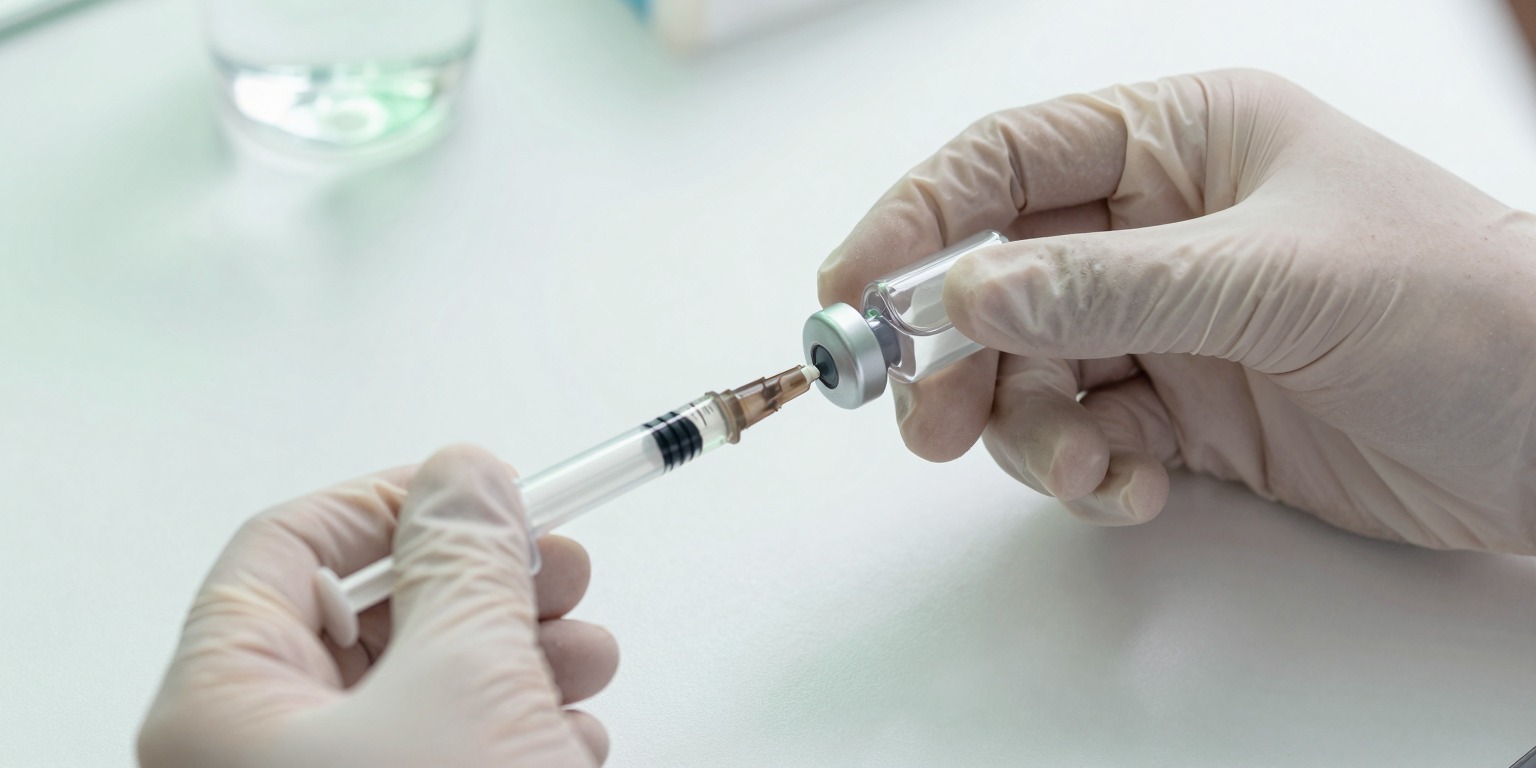 Accurate reconstitution is essential for peptides like BPC-157: even small dilution errors shift the effective dose significantly.
TB-500: Systemic Healing for High-Volume Athletes
Thymosin Beta-4 (TB-500) is a synthetic version of a naturally occurring peptide that promotes actin regulation, angiogenesis, and cell migration, all critical processes in tissue repair. Like BPC-157, its muscle-growth case is largely recovery-mediated: athletes with fewer injuries, less chronic inflammation, and better tissue quality can train harder and more consistently over time.
Research in horses (where TB-500 is used veterinarily) and rodent models shows meaningful tendon and cardiac tissue repair. Human trials are limited. Some users report improved flexibility and reduced chronic soreness with extended low-dose protocols, but these are anecdotal observations rather than controlled data.
Typical reported protocol: 2-2.5 mg twice weekly for a loading phase of 4-6 weeks, then reduced to a maintenance dose. TB-500 is often stacked with BPC-157 for synergistic tissue repair.
Hexarelin: Potent but Demanding
Hexarelin is one of the most potent GHRPs available, producing large GH pulses. It is sometimes used for short, aggressive cycles when maximum GH stimulus is the goal. The trade-off is a higher likelihood of side effects including elevated prolactin and cortisol, plus rapid desensitisation with prolonged use. Most protocols cap it at 4-6 weeks.
Animal research confirms strong anabolic and cardioprotective effects; controlled human data for muscle hypertrophy specifically is minimal. It sits further along the risk-benefit curve than Ipamorelin for most users.
Track Your Protocol with Redose
If you're running any of these compounds, dosing accuracy and consistency matter. Redose (download here) lets you log every injection with one tap, track remaining vial volume, rotate injection sites automatically, and generate a summary you can share with a healthcare provider, all offline-first, so nothing gets missed.
What to Keep in Mind
The best peptides for muscle growth work most effectively as part of a foundation that already includes structured resistance training, adequate protein intake, and quality sleep. No peptide substitutes for those fundamentals. Most compounds discussed here are investigational research chemicals: they are not regulated for manufacturing quality, and dosing errors carry real physiological risk. Source verification, precise reconstitution (see /guides/how-to-reconstitute-peptides), and medical supervision are not optional extras.
If you're newer to this space, what are peptides is a useful primer before committing to any protocol.
This article is educational information, not medical advice. Talk to a qualified healthcare provider before starting any protocol.