 Redose
Constipation on tirzepatide doesn't climb with the dose the way nausea does. In the two placebo-controlled weight trials behind the Zepbound label, 17% of people on 5 mg reported it, compared with 14% on 10 mg, 11% on 15 mg and 5% on placebo.
That runs against how most people picture Zepbound constipation, as something that gets worse every time the pen strength goes up. Below is what the prescribing information and the semaglutide trials actually recorded, how long it tended to last, and which questions are worth taking to a prescriber. Redose is built for tracking and record-keeping only, so none of this replaces that conversation.
What the label shows about Zepbound side effects in the gut
Lilly's Zepbound prescribing information pools Study 1 and Study 2, with 958 people on placebo and between 630 and 948 in each tirzepatide arm. The constipation row also counts hard stools, and it measures how many people reported the problem, not how bad it got.
| Weekly dose | Constipation | Diarrhea |
|---|---|---|
| Placebo | 5% | 8% |
| 5 mg | 17% | 19% |
| 10 mg | 14% | 21% |
| 15 mg | 11% | 23% |
Read the two columns side by side and the shape is hard to miss. Diarrhea rises from 19% to 23% as the dose goes up, while constipation falls from 17% to 11%. Across every dose, 56% of people on tirzepatide reported some gastrointestinal reaction, against 30% on placebo.
In the Zepbound weight trials, constipation was reported by 17% of people on 5 mg and 11% on 15 mg. The lowest maintenance dose had the highest rate.
Why Zepbound constipation peaks at the 5 mg dose
Nobody in these trials jumped straight to the top dose. The label starts everyone at 2.5 mg weekly for 4 weeks, then moves up in 2.5 mg steps with at least 4 weeks on each, so people assigned to 15 mg passed through 5 mg and 10 mg on the way. Our tirzepatide dosage chart lays out the full climb.

Every arm climbed the same ladder
That matters for reading the table. The 15 mg group spent its early months on the same lower doses as everyone else, yet still ended up with fewer constipation reports overall. Dose alone clearly isn't the whole story.
Why the lower dose might look worse
The label doesn't explain the gap, and it's worth being careful. One possible reading, which the data don't confirm, is that the looser stools seen more often at higher doses offset some constipation. Another is ordinary variation between groups of a few hundred people. Neither tells you how severe any one person's symptoms were.
Mounjaro constipation looks smaller in the diabetes trials
The same molecule tells a slightly different story in people with type 2 diabetes. In the Mounjaro placebo-controlled pool, constipation was reported by 6% on 5 mg, 6% on 10 mg and 7% on 15 mg, against 1% on placebo. In a cardiovascular outcomes trial of 6,647 adults, it reached 13%.

- Zepbound weight trials: 11% to 17% on tirzepatide, 5% on placebo
- Mounjaro diabetes pool: 6% to 7% on tirzepatide, 1% on placebo
- Mounjaro outcomes trial: 13% of 6,647 adults reported constipation
- Both labels list fecal impaction among reports made after approval
So constipation on Mounjaro isn't rare, but the trial populations, doses and lengths differ, which is why the percentages don't line up neatly. Both labels also list ileus, intestinal obstruction and severe constipation including fecal impaction among postmarketing reports, where true frequency can't be estimated.
Mounjaro side effects that travel together
Constipation with Mounjaro rarely shows up alone in the label tables. Nausea ran from 12% to 18% across doses, diarrhea from 12% to 17% and decreased appetite from 5% to 11%, all above placebo. Eating and drinking less can leave stools harder, which is one reason people log intake next to symptoms.
How long semaglutide constipation lasted in the STEP trials
The best duration data come from semaglutide, not tirzepatide. A pooled analysis of STEP 1 to 3 by Wharton and colleagues found constipation in 24.2% of people on semaglutide 2.4 mg and 11.1% on placebo. The median episode lasted 47 days on the drug and 35 days on placebo.
Median length of a constipation episode in the pooled STEP trials: 47 days on semaglutide 2.4 mg and 35 days on placebo. That's roughly seven weeks against five.
Constipation prevalence in that analysis leveled off around week 10, while nausea, diarrhea and vomiting peaked near week 20, after the 16 week escalation. Across all gut complaints, 98.1% were rated mild or moderate. The current Wegovy label lists constipation at 24% versus 11% on placebo, in line with that pool.
Ozempic constipation versus Zepbound
People who switch drugs often ask whether Ozempic constipation is worse. Comparing separate trials is shaky because the populations and designs differ, but the 24% semaglutide 2.4 mg figure sits above the 11% to 17% range in the Zepbound pool. Only a head-to-head trial could settle which drug causes more.
What untracked constipation costs in lost weeks on treatment
The bigger risk usually isn't the discomfort. It's gut trouble pushing someone off a drug they were doing well on. In the Zepbound trials, 1.9% of people on 5 mg, 3.3% on 10 mg and 4.3% on 15 mg stopped because of gastrointestinal reactions, against 0.5% on placebo, and most stops came in the first few months.
For Wegovy, 4.3% of adults in the weight trials quit over a gastrointestinal reaction, compared with 0.7% on placebo. Each exit throws away weeks spent climbing the titration schedule. A dated log gives a prescriber something concrete to work with instead of a fuzzy memory of a bad month.
- Date and dose of each injection, plus the pen or vial strength
- Days since your last bowel movement, noted once a day
- Rough daily water intake in mL or cups
- Grams of fiber eaten, taken from labels or a food app
- Any pain, bloating or vomiting, and when it started
Patterns worth showing a prescriber
Two weeks of entries can show whether symptoms cluster in the 2 to 3 days after an injection, follow a dose increase, or track with low water days. That's detail a clinician can act on. If you're working from a vial, the dose calculators handle the syringe unit math, and the tirzepatide profile covers the basics.
Fiber for constipation and other options to ask about
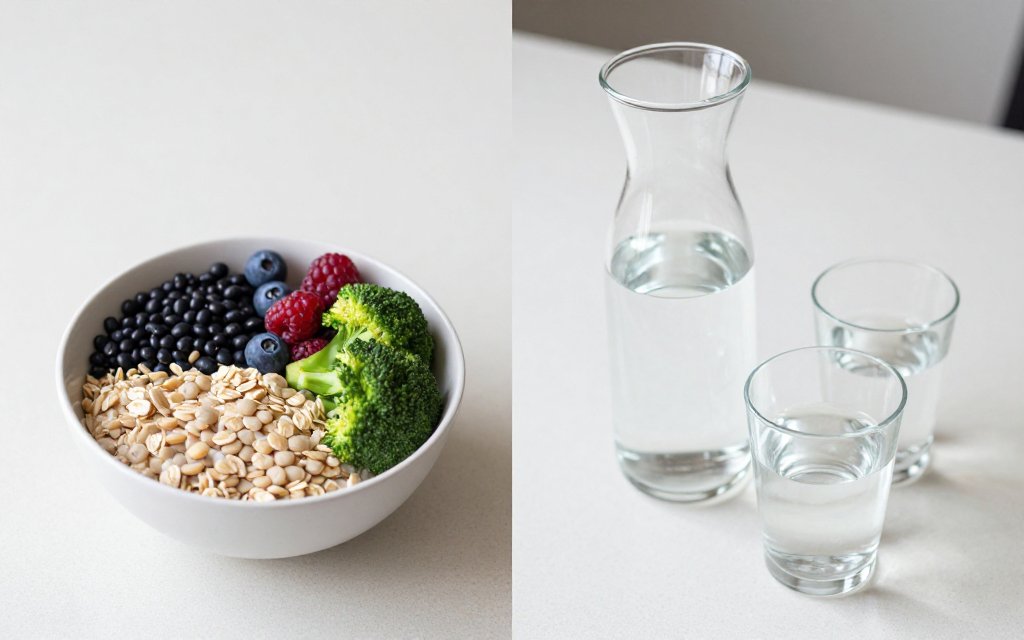
Constipation guidance from the NIDDK, part of the US National Institutes of Health, suggests adults get 22 to 34 grams of fiber a day, added a little at a time, with water and other fluids to help it work and keep stools soft. Foods it names include oatmeal, lentils, black beans, berries, pears, broccoli and almonds.
Fiber supplements for constipation, such as psyllium, are another route, though they also need fluid alongside them. Osmotic laxatives come up constantly in GLP-1 constipation threads, including polyethylene glycol and magnesium citrate for constipation. Which fits, and how much, depends on kidney function, other medicines and your history, so that's a pharmacist or prescriber question.
- Add fiber a few grams at a time to limit gas and bloating
- Pair every fiber increase with more water and other fluids
- Ask a pharmacist before magnesium products if kidneys are a concern
- Severe belly pain that won't go away needs a prompt clinician call
Fiber without fluid can backfire. The NIDDK pairs its 22 to 34 gram daily target with water and other liquids to keep stools soft.
If loose stools are the bigger issue for you, our piece on sulfur burps and diarrhea on Ozempic covers the other side of the gut. Alcohol dehydrates too, which our Zepbound and alcohol explainer walks through.
Questions people ask about GLP-1 constipation
How long does Zepbound constipation last?
The Zepbound label doesn't give a duration. The closest published figure comes from semaglutide, where the pooled STEP trials recorded a median of 47 days per episode. Constipation that runs well past that, or comes with pain, is worth raising with a prescriber.
Does a lower dose mean less constipation?
Not according to the weight trials, where 5 mg had the highest rate at 17%. The label does say a lower maintenance dose can be considered when one isn't tolerated, with 5 mg, 10 mg and 15 mg all approved for maintenance. Any change is the prescriber's call.
Are Zepbound side effects worse after each dose increase?
For nausea, vomiting and diarrhea, the label says most events happened during dose escalation and eased over time. In the semaglutide data, constipation leveled off around week 10. Logging the week of each increase makes it easier to see whether your own pattern matches.
When should constipation on a GLP-1 prompt a call?
Both tirzepatide labels list intestinal obstruction and fecal impaction among postmarketing reports. The patient information also says to call a healthcare provider right away for severe stomach pain that won't go away, with or without vomiting. Don't wait that kind of pain out.
Track every dose and every side effect with confidence. Download Redose and get exact syringe units from the calculator, gentle reminders, injection site rotation, and a complete private log of your protocol to share with your prescriber. Get the app here: iOS.