 Redose
Ipamorelin, CJC-1295, and sermorelin are three of the most widely discussed growth hormone secretagogues (GHS): compounds that encourage the pituitary gland to release more of its own growth hormone rather than directly supplying exogenous GH. The ipamorelin CJC-1295 combination has become particularly prominent, but sermorelin has a longer clinical track record. Understanding how each works, how they differ, and where the evidence stands helps put these compounds in proper perspective.
Important: None of these peptides are FDA-approved for use in healthy adults. They are investigational compounds. Everything below is educational context, not a treatment recommendation.
How Each Compound Works
All three ultimately increase pituitary GH secretion, but they operate through distinct receptor pathways.
Sermorelin: the GHRH analogue
Sermorelin is a synthetic version of the first 29 amino acids of naturally occurring growth hormone-releasing hormone (GHRH). It binds to GHRH receptors on pituitary somatotroph cells, stimulating GH synthesis and release in a manner that mirrors the body's normal pulsatile signalling. Because it follows physiological feedback loops, the pituitary can still be suppressed by elevated IGF-1, which limits runaway GH excess.
Sermorelin was once FDA-approved as Geref for children with GH deficiency. That branded product has been discontinued, but compounded sermorelin is still prescribed off-label by some physicians for adult GH optimisation.
Ipamorelin: the selective GHRP
Ipamorelin is a growth hormone-releasing peptide (GHRP) and ghrelin-receptor agonist. It binds to the GHS-R1a receptor (different from the GHRH receptor), triggering GH release through a separate intracellular cascade. Ipamorelin is considered one of the more selective GHRPs because, at standard doses, it shows minimal effect on cortisol and prolactin compared with older GHRPs such as GHRP-2 or GHRP-6. It also produces less pronounced hunger stimulation than GHRP-6.
CJC-1295: the long-acting GHRH analogue
CJC-1295 is a modified GHRH analogue engineered for extended half-life. The version with Drug Affinity Complex (DAC) binds reversibly to albumin in the bloodstream, extending its activity to roughly six to eight days from a single injection, turning a normally short-lived GHRH signal into a sustained one. A version without DAC (sometimes called Modified GRF 1-29) acts more like sermorelin in duration and is often used for twice-daily dosing alongside ipamorelin.
Ipamorelin + CJC-1295: Why Combine Them?
Because ipamorelin (GHRP pathway) and CJC-1295 (GHRH pathway) work on different receptors, they produce an additive, potentially synergistic GH pulse when used together. The GHRH component raises baseline "permissive" signalling, while the GHRP component amplifies pulsatile release. This dual-receptor approach is the core rationale behind the popular ipamorelin CJC-1295 stack.
In contrast, sermorelin alone provides only GHRH-pathway stimulation. Some clinicians combine ipamorelin with sermorelin for a similar dual-receptor effect, treating sermorelin as a shorter-acting substitute for CJC-1295.
Head-to-Head Comparison
| Factor | Sermorelin | Ipamorelin | CJC-1295 (with DAC) |
|---|---|---|---|
| Receptor pathway | GHRH receptor | GHS-R1a (ghrelin receptor) | GHRH receptor |
| Half-life | ~10-20 minutes | ~2 hours | ~6-8 days |
| Injection frequency | Nightly (5-7×/week) | 1-3× daily | 1-2× per week |
| Typical dose | 0.2-0.3 mg per injection | 100-300 mcg per injection | 1-2 mg per injection |
| GH pulse profile | Mimics natural nocturnal pulse | Amplifies existing pulses | Elevates baseline GH tonically |
| Effect on cortisol/prolactin | Minimal | Minimal (selective) | Minimal |
| Clinical approval history | Former FDA approval (paediatric GHD) | None, investigational | None, investigational |
| Common side effects | Water retention, headache, injection-site reactions | Water retention, hunger increase, mild headache | Water retention, joint aches, possible cortisol blunting at high doses |
| Best studied in | Adults and children with GH deficiency | Animal and early human research | Primarily in vitro and animal; limited human data |
| Often combined with | Ipamorelin or used alone | CJC-1295 or sermorelin | Ipamorelin |
Typical Protocol Structures
Sermorelin alone
A common clinician-supervised protocol uses 0.2-0.3 mg subcutaneously before bed, leveraging the body's natural nocturnal GH surge. Labs (typically IGF-1 and fasting glucose) are drawn at baseline and rechecked at 3-6 months. Protocols typically run 3-6 months at a time.
Ipamorelin + CJC-1295 (Modified GRF)
The most widely discussed stack uses 100-200 mcg ipamorelin paired with 100-200 mcg CJC-1295 without DAC (Modified GRF 1-29), injected subcutaneously twice daily, typically before training and before sleep. Both peptides are often reconstituted separately and drawn into the same syringe just before injection. For guidance on reconstitution, see our how-to-reconstitute-peptides guide.
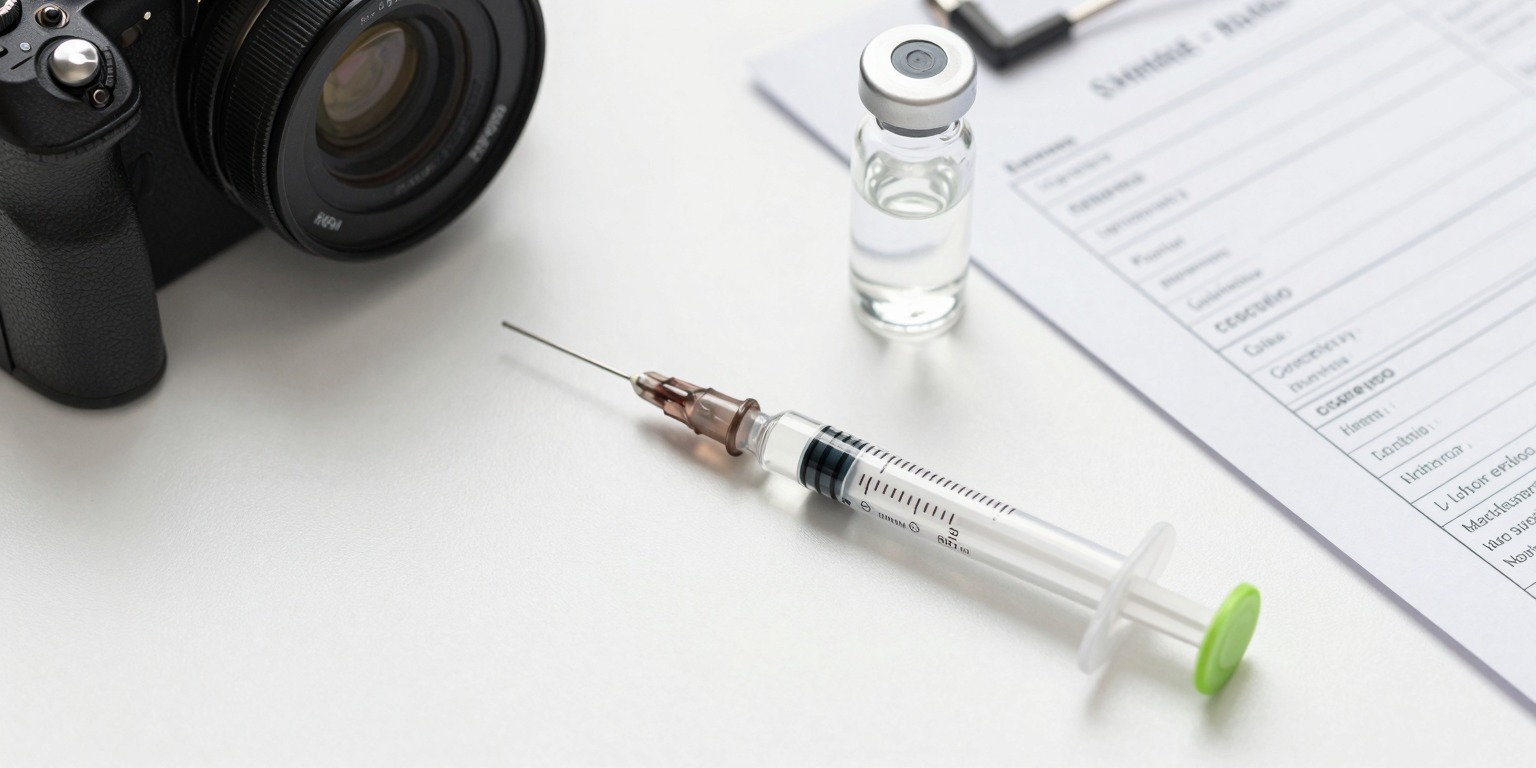 The typical tools of a clinician-supervised GH secretagogue protocol: a vial, syringe, and baseline labs.
Ipamorelin + CJC-1295 (with DAC)
When using the longer-acting DAC version, a common approach is 1-2 mg CJC-1295 once or twice per week paired with ipamorelin 200-300 mcg once or twice daily. The sustained GHRH background from CJC-1295 means ipamorelin injections are layered on top of an already-elevated baseline, which is why some protocols use lower ipamorelin doses with DAC than without.
To avoid manual dose maths on peptide concentrations, the free Redose reconstitution and dosing calculators handle the unit conversions for you.
What Does the Evidence Actually Show?
Sermorelin
Sermorelin has the strongest human evidence base of the three because it was studied for a specific clinical indication. Trials in children with GH deficiency showed meaningful increases in growth velocity. In adults with age-related GH decline, small studies have reported improvements in lean mass and sleep quality, though effect sizes were modest and long-term outcomes are not well-established.
Ipamorelin
Early research in animal models and a handful of small human trials confirm that ipamorelin raises GH and IGF-1. Phase II clinical trials explored it for post-operative ileus (showing tolerability), but no large, long-term, randomised trials in healthy adults have been published. Evidence for benefits in body composition, recovery, or aging is preliminary and largely anecdotal or extrapolated from animal data.
CJC-1295
Phase I/II trials demonstrated dose-dependent increases in GH and IGF-1 lasting up to 14 days after a single dose. These were pharmacokinetic and safety studies, not outcome trials. There are no published randomised controlled trials evaluating CJC-1295 for body composition or performance in healthy humans.
Bottom line on evidence: Sermorelin has the most human safety data; ipamorelin and CJC-1295 are supported by early-phase human studies and extrapolation from animal research. None have been through large Phase III trials for the wellness indications they are typically discussed for.
Side Effects and Safety Considerations
All three share a broadly similar side-effect profile because they all increase GH and downstream IGF-1:
- Water retention and puffiness, especially at initiation
- Joint discomfort at higher doses due to fluid shifts
- Mild headache and fatigue, usually transient
- Elevated appetite, more pronounced with ipamorelin than sermorelin at typical doses
- Injection-site reactions (redness, bruising, nodules), proper injection-site rotation reduces cumulative tissue irritation
- Elevated IGF-1 carries theoretical long-term concerns around proliferative conditions; this is a key reason why regular blood work is considered essential
Ipamorelin's lower propensity to spike cortisol and prolactin relative to older GHRPs is one reason it's often preferred, but this selectivity is dose-dependent and has primarily been demonstrated in rodent models.
Track Your Protocol with Redose
If you're working with a clinician on a GH secretagogue protocol, keeping accurate records matters: dose timing, injection sites, symptom notes, and vial inventory all add up to a clear picture over weeks and months. Redose is a free iPhone and Android app built specifically for peptide protocols: one-tap dose logging, injection-site rotation reminders, vial inventory tracking, and exportable PDF reports you can share with your doctor.
Which Should You Consider?
- Sermorelin suits those who want the compound with the longest clinical track record, a once-nightly injection schedule, and a mechanism closely mirroring natural GHRH signalling.
- Ipamorelin alone is sometimes used for mild, pulse-amplifying effects with a relatively clean side-effect profile.
- Ipamorelin CJC-1295 is the most commonly discussed stack when the goal is a more robust GH response, though it requires more injections (or less frequent injections with the DAC version) and the evidence base remains early-stage.
None of these are over-the-counter products, and choosing between them involves weighing your medical history, existing lab values, and goals with a qualified clinician. Internet forums are not a substitute for that conversation.
Conclusion
Sermorelin, ipamorelin, and CJC-1295 each target the growth hormone axis from slightly different angles. Sermorelin offers a GHRH-mimetic mechanism with more clinical history; ipamorelin brings GHRP-pathway selectivity; and CJC-1295 extends GHRH signalling over days rather than minutes. The popular ipamorelin CJC-1295 combination stacks both pathways for an additive GH effect, but remains an investigational approach with limited long-term human outcome data.
This article is educational information, not medical advice. Talk to a qualified healthcare provider before starting any protocol.