 Redose
A peptide reconstitution chart is the fastest way to go from a dry powder vial and a bottle of bacteriostatic water to a syringe-ready dose without doing the math by hand. The reference tables below cover the most common vial sizes, water volumes, and target doses so you can confirm your concentration and read off the exact units to draw on a U-100 insulin syringe.
Important: All peptides discussed here are investigational research compounds. None of the dosing information below constitutes medical advice, and most of these peptides are not approved by the FDA for human use. Always consult a qualified healthcare professional before beginning any peptide protocol.
The Core Formula
Before reading the charts, it helps to understand the single calculation behind every row:
Concentration (mcg/mL) = Vial mass (mg) × 1,000 ÷ BAC water added (mL)
Once you have the concentration, the units to draw on a U-100 syringe for any dose is:
Units = Desired dose (mcg) ÷ Concentration (mcg/mL) × 100
For example: 5 mg vial, 2 mL BAC water → 2,500 mcg/mL. For a 250 mcg dose: 250 ÷ 2,500 × 100 = 10 units.
If you prefer to skip the arithmetic entirely, the free Redose reconstitution calculator lets you enter your vial size, water volume, and target dose and shows the units instantly.
Peptide Reconstitution Chart, Common Vial Sizes
The tables below use a U-100 insulin syringe as the reference. All doses are in micrograms (mcg). Round to the nearest unit when drawing.
2 mg Vials
| BAC Water Added | Concentration | 100 mcg dose | 200 mcg dose | 500 mcg dose |
|---|---|---|---|---|
| 1 mL | 2,000 mcg/mL | 5 units | 10 units | 25 units |
| 2 mL | 1,000 mcg/mL | 10 units | 20 units | 50 units |
| 4 mL | 500 mcg/mL | 20 units | 40 units | 100 units |
5 mg Vials
| BAC Water Added | Concentration | 250 mcg dose | 500 mcg dose | 1,000 mcg dose |
|---|---|---|---|---|
| 1 mL | 5,000 mcg/mL | 5 units | 10 units | 20 units |
| 2 mL | 2,500 mcg/mL | 10 units | 20 units | 40 units |
| 5 mL | 1,000 mcg/mL | 25 units | 50 units | 100 units |
10 mg Vials
| BAC Water Added | Concentration | 250 mcg dose | 500 mcg dose | 1,000 mcg dose |
|---|---|---|---|---|
| 1 mL | 10,000 mcg/mL | 2.5 units | 5 units | 10 units |
| 2 mL | 5,000 mcg/mL | 5 units | 10 units | 20 units |
| 10 mL | 1,000 mcg/mL | 25 units | 50 units | 100 units |
Tip: Smaller BAC water volumes produce higher concentrations, meaning you inject a smaller total volume per dose. Researchers often prefer 2 mL for 5 mg vials as a practical middle ground: fine enough to read on the syringe, not so dilute that injection volume becomes inconvenient.
Peptide-Specific Reference Doses
The table below summarizes dose ranges commonly reported in the literature or used in preclinical and early clinical studies. These are not prescriptions. Actual protocols vary based on the compound, goal, and individual health status.
| Peptide | Common Vial Size | Typical Dose Range | Frequency (common protocols) |
|---|---|---|---|
| BPC-157 | 5 mg | 200-500 mcg | Once or twice daily |
| TB-500 (Thymosin β-4 fragment) | 5 mg | 2,000-2,500 mcg | 2× per week (loading), 1× per week (maintenance) |
| CJC-1295 (no DAC) | 2 mg or 5 mg | 100-300 mcg | 1-3× daily (often with a GHRP) |
| Ipamorelin | 2 mg or 5 mg | 100-300 mcg | 1-3× daily |
| Sermorelin | 3 mg or 9 mg | 200-500 mcg | Once daily at bedtime |
| PT-141 (Bremelanotide) | 10 mg | 1,000-2,000 mcg | As needed, not daily |
| Selank | 5 mg | 250-500 mcg | Once or twice daily |
| Hexarelin | 2 mg | 100-200 mcg | 1-2× daily |
All of the above are investigational compounds with varying levels of human evidence. BPC-157 and TB-500 remain in the research phase with most published data from animal models. CJC-1295 and Ipamorelin have appeared in small human pharmacokinetic studies. PT-141 (bremelanotide) is the exception: it has received FDA approval as Vyleesi for hypoactive sexual desire disorder at a specific dose via a different administration route; the OTC research-grade version is a distinct regulatory category.
How to Reconstitute a Peptide (Quick Reference)
If this is your first reconstitution, the full step-by-step walkthrough is in the peptide reconstitution guide. The short version:
- Gather supplies: lyophilized peptide vial, bacteriostatic water, alcohol swabs, U-100 insulin syringe.
- Wipe both rubber stoppers with a fresh alcohol swab and let them air-dry for 30 seconds.
- Draw the BAC water into the syringe (use the volume from the chart above for your desired concentration).
- Inject the BAC water slowly down the inside wall of the vial, do not shoot it directly onto the powder cake or agitate forcefully.
- Gently swirl (never shake) until the powder is fully dissolved and the solution is clear.
- Label the vial with the date and concentration, then refrigerate at 2-8 °C.
Most reconstituted peptides are stable for 2-4 weeks refrigerated. Discard if the solution becomes cloudy, discolored, or develops particulates.
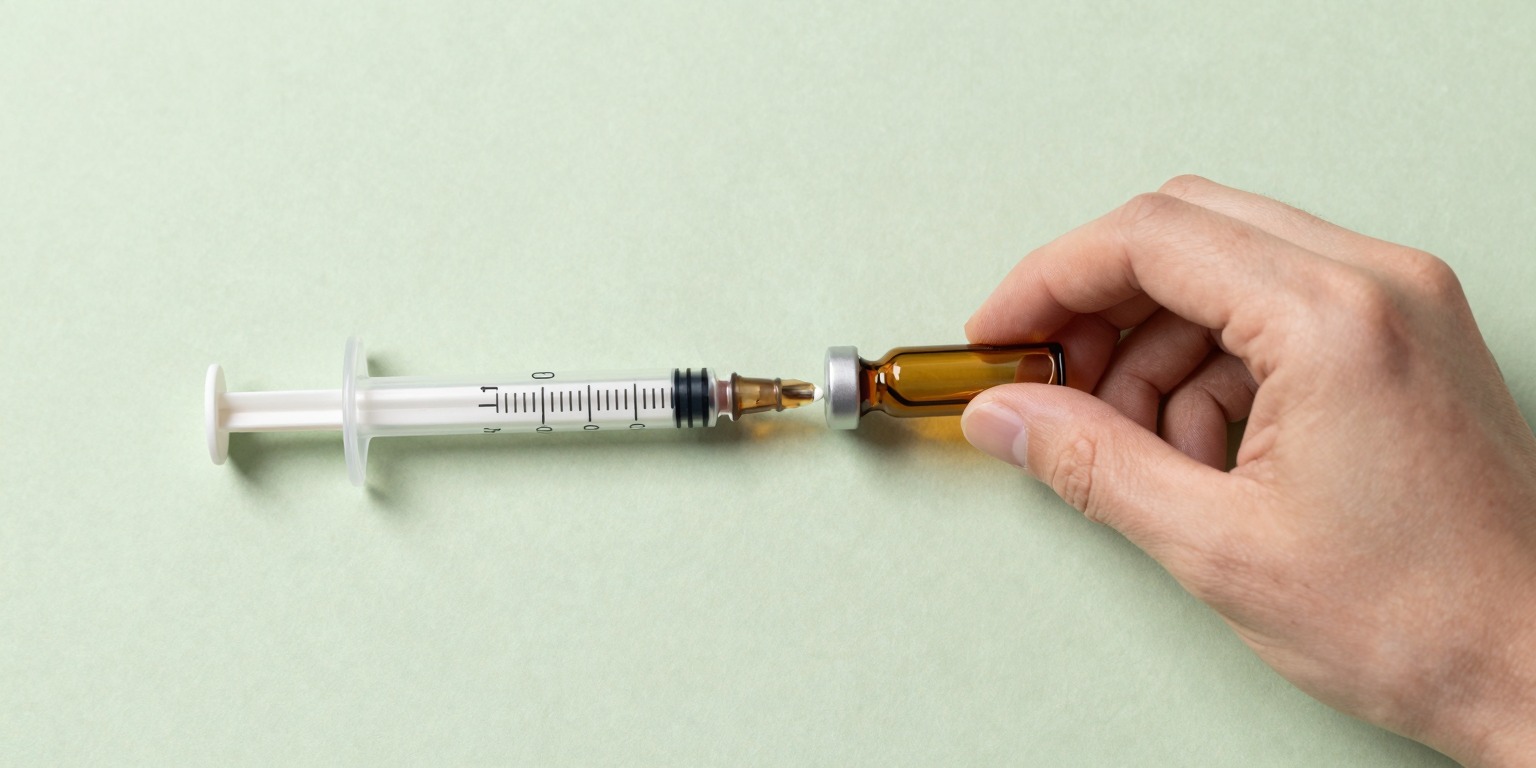 Drawing to the correct unit mark on a U-100 syringe is the final step before injection.
Reading Syringe Units Accurately
U-100 insulin syringes have 100 graduation marks per mL, so each "unit" equals 0.01 mL. This is the most practical syringe for peptide dosing because the small barrel makes it easy to measure single-digit unit amounts.
- A 10-unit draw = 0.10 mL
- A 25-unit draw = 0.25 mL
- A 50-unit draw = 0.50 mL
If your calculated units fall between marks, draw to the nearest whole unit, the resulting dose difference is negligible at research scales. For very small doses (under 5 units), consider diluting further to improve syringe accuracy.
Avoid U-40 syringes for peptide work unless you recalculate your chart values: U-40 syringes have 40 units per mL, not 100, so the unit readings in the tables above do not apply.
Injection Site Rotation
Subcutaneous injections are the most common route for research peptides. Rotating sites (abdomen, thighs, upper arms) reduces local irritation and scar tissue over time. If you want a visual reference and a system for tracking which site you used last, the injection site rotation guide covers the 20 most commonly used subcutaneous locations.
Track This with Redose
Keeping a manual log of vial batches, reconstitution dates, concentrations, and injection sites gets complicated fast, especially when running multiple peptides. Redose handles all of it: you enter your vial size and BAC water volume once, and the app tracks remaining inventory, dose history, and site rotation automatically, so your logs stay accurate without extra effort.
Common Reconstitution Mistakes
- Using sterile water instead of bacteriostatic water for multi-dose vials, plain sterile water has no preservative and should only be used for single-dose applications.
- Injecting BAC water too fast directly onto the powder, which can damage peptide structure through mechanical shear.
- Skipping the label, a reconstituted vial in the fridge with no date or concentration written on it is a safety hazard.
- Drawing from a frozen vial without letting it thaw fully at room temperature first.
- Storing at room temperature, most peptides degrade significantly faster above 8 °C once reconstituted.
Quick Conversion Reference
| Measurement | Equivalent |
|---|---|
| 1 mg | 1,000 mcg |
| 1 mL | 100 units (U-100 syringe) |
| 0.1 mL | 10 units |
| 0.01 mL | 1 unit |
Conclusion
A reliable peptide reconstitution chart removes the guesswork between a dry powder vial and a correctly dosed injection. The tables above cover the most common vial sizes (2 mg, 5 mg, 10 mg) and BAC water volumes so you can confirm concentration and units at a glance. For non-standard setups, the free calculator at /calculators handles any combination of inputs. Store reconstituted peptides refrigerated, label every vial, and rotate injection sites to maintain protocol quality over time.
This article is educational information, not medical advice. Talk to a qualified healthcare provider before starting any protocol.