 Redose
Most people on a GLP-1 watch the scale fall fast for a few months, then it just stops. That flat stretch is the weight loss plateau, and in the pivotal semaglutide trial it arrived around week 60. It is one of the most predictable points in the whole protocol, and it still blindsides almost everyone.
Here is the reassuring part. The weight loss plateau is not the drug quitting. Published trials show it is your body settling at a lower number after the steep early drop, and the timing holds up across semaglutide and tirzepatide. Redose is a tracking and record-keeping tool, not medical advice, so read every figure below as what trials reported and what to raise with your prescriber.
What a weight loss plateau really is
A plateau is a stall in weight that lasts weeks while your dose and your habits stay put. On a GLP-1 it usually shows up after the fast phase, once a smaller body and a quieter appetite reach a new balance. Some people call it a weight loss slump and others a weight loss stall, but the mechanism underneath is the same.
A plateau is your body defending a lower set point, not proof the medication has quit.
When the plateau tends to hit
Measurable loss usually begins around week 4, once the dose climbs past the small starter amounts. It runs steepest through months three to nine. In the STEP 1 timeline, semaglutide 2.4 mg kept working until roughly week 60, then held near a 14.9 percent loss at 68 weeks. Tirzepatide stretches that runway a little longer.
| Medication | Plateau week | Weight lost |
|---|---|---|
| Semaglutide 2.4 mg | 68 | 14.9% |
| Tirzepatide 5 mg | 72 | 15.0% |
| Tirzepatide 10 mg | 72 | 19.5% |
| Tirzepatide 15 mg | 72 | 20.9% |
Higher doses pushed the number further before the plateau during weight loss set in. Tirzepatide at 15 mg averaged a 20.9 percent loss by week 72, while the 5 mg dose landed near 15.0 percent. If you want to see how those steps climb, the tirzepatide titration ladder lays each stage out.
In STEP 1, weight kept falling until about week 60, then settled near a 14.9 percent loss and held there.

Why the plateau happens
The plateau is not one thing. Two mechanisms overlap, and one of them matters far more than the headlines suggest.
The appetite feedback circuit weakens
Appetite regulation runs on a feedback loop, and GLP-1 drugs weaken it. A 2023 modeling study put the feedback gain at 49 kcal per day per kg on semaglutide, down from about 95 at baseline. A weaker loop means hunger returns more slowly, which is why the loss runs for a year before the curve flattens.
Metabolic adaptation plays a smaller role
Metabolic adaptation gets most of the blame, but the same model found its role is smaller here. Baseline energy expenditure has limited room to fall, so the plateau is driven more by appetite creeping back than by a crashing metabolism. That distinction changes what actually helps.
Models put the semaglutide plateau near 24 months, far later than the 12 months seen with diet alone.
What the plateau means for your results
This is where the plateau meets real life. Trial averages are not what most people see. Real world data lands near an 8.7 percent loss at one year, while those who stayed on treatment reached 11.9 percent and early stoppers managed only 3.6 percent.
| Group | Timeframe | Weight lost |
|---|---|---|
| STEP 1 trial | 68 weeks | 14.9% |
| Real world | 12 months | 8.7% |
| Stayed on drug | 12 months | 11.9% |
| Stopped early | 12 months | 3.6% |
A plateau is a good moment to look past the scale. Clinicians point to blood pressure, waist size and energy as better markers than a single number. Some of the weight lost is muscle, which is why the muscle you keep during weight loss shapes how you look and how your metabolism holds up.
- The scale holds within a pound for three weeks
- Appetite creeps back in the days before your dose
- Weekly loss slips under half a pound and stays
- Old portion sizes quietly return at dinner
How a GLP-1 plateau shows up in your log
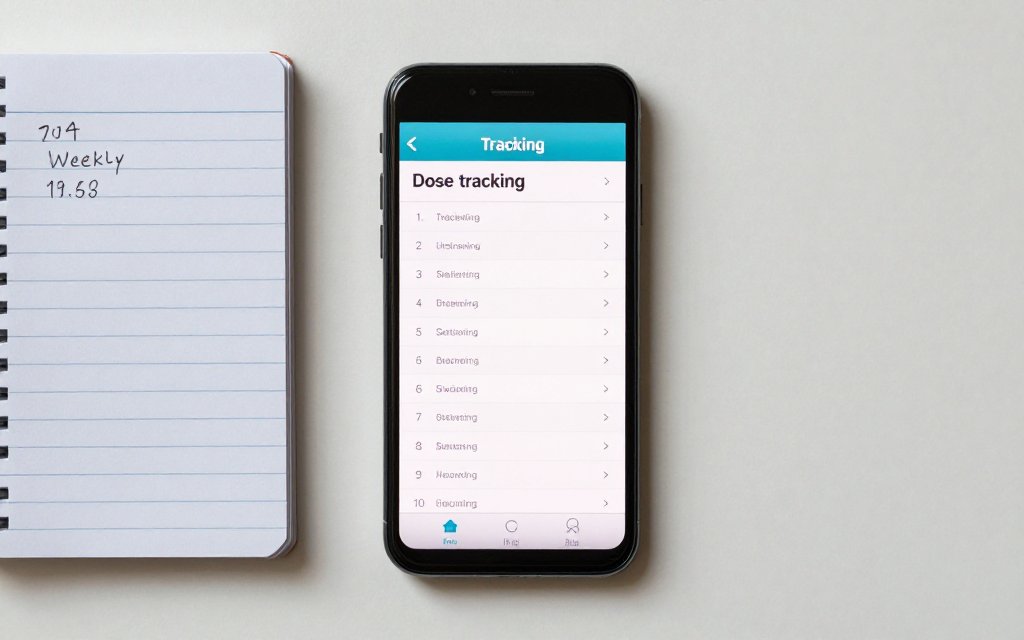
A plateau is easier to read when you have clean records. Exact doses in syringe units, injection dates and weekly weights turn a vague sense of stalling into a clear pattern. The syringe unit calculator handles the dose math, and the log stays private, for tracking and record-keeping only.
- The exact dose in milligrams and syringe units
- The date and body site of every injection
- Weekly weight and waist measurement trends
- How strong appetite and food noise feel
Watch the days right before each dose. When hunger gets louder late in the week, that is often the first sign of a stall, not a failure of willpower. Logging how food noise behaves across the week gives your prescriber something concrete to work with.
Tips for weight loss plateau to raise with your prescriber
The label sets the dose schedule, and changing it is a conversation with your prescriber, never a solo call. What you can do is arrive with clean data. These are simple habits that make a plateau visible.
- Weigh once a week, same day, scale and time
- Log protein grams and total calories for two weeks
- Note resistance training days and hours of sleep
- Record appetite return in the 48 hours before a dose
A diet weight loss plateau responds to the same honesty: protein, calories and training logged for two weeks tell the real story. If a switch comes up, it helps to know how tirzepatide compared with semaglutide in a head to head trial.
Common questions about the Ozempic plateau
Why am i not losing weight on ozempic?
Most likely you have reached the normal plateau, often around week 60, where a smaller body burns fewer calories and appetite has partly returned. A weight plateau of two or three weeks is expected and does not mean the medication has stopped working. Bring your dose, weight and food logs to your prescriber before assuming anything is wrong.
Why am i not losing weight on mounjaro?
Tirzepatide follows the same curve, just a little later. The tirzepatide plateau tends to arrive a few weeks after semaglutide's, often near week 72 at higher doses. If your loss has been flat for weeks despite steady habits, that pattern is worth reviewing with the person who prescribes it.
Does an ozempic plateau mean the drug has stopped working?
No. An ozempic plateau usually means your body has found a new balance, not that the drug quit. Trials show weight holding at the plateau rather than climbing back while treatment continues. The phrase ozempic stopped working describes how it feels, not what the biology shows.
How long does a weight loss stall last?
It varies. A short weight loss stall of two to four weeks is common and often resolves on its own. A longer stretch with no change in weight, waist or energy is the point to review your logs and next steps with your prescriber, who can weigh the options against the label.
A plateau is easier to sit with when you can see the whole picture. Track every dose with confidence, log your weight and appetite trends, keep your injection sites rotating, and hold a complete private record of your protocol through the weight loss plateau and beyond. Get the app here: iOS.